Sovereignty at what price? Mathias Burghardt at Les Rencontres Économiques d’Aix-en-Provence
Market watch
Sovereignty at what price? Mathias Burghardt at Les Rencontres Économiques d’Aix-en-Provence
-
08 July 2026
-
Ardian
Reading time: 5 minutes
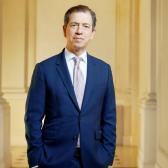
Mathias Burghardt
Chairman of the Infrastructure Management Committee
Mathias Burghardt founded Ardian’s Infrastructure business over twenty years ago and led it until 2026. He is now overseeing the activity, as Chairman of the Infrastructure Management Committee. Under his direction, the activity has become a leading global player, managing nearly $50 billion in assets across Europe and the Americas. Committed to the transformation and decarbonization of portfolio companies, he has also launched dedicated investment platforms focused on low-carbon hydrogen and Nature-Based Solutions (NBS), aimed at accelerating industrial transition, fostering innovation, and contributing to the development of tomorrow’s economy.
He has led Ardian’s Technology and Innovation strategy since 2019, delivering several major achievements, including the creation of Ardian’s Data Science team, responsible for defining and deploying the firm’s Data and Artificial Intelligence strategy in support of Ardian’s performance and that of its portfolio companies.
Today, he has developed extensive relationships with international industrial companies and financial sponsors, public authorities and regulators. Vice-President of the Board of Directors of Nuova Argo Finanziaria, the controlling holding company of the ASTM Group (the world's second-largest toll road operator), Mathias Burghardt has also been a board director of major infrastructure companies such as London Luton Airport, SANEF and the parking company INDIGO.
Mathias joined Ardian in 2007. He started his career in 1989 with Crédit Lyonnais in Media Telecom before heading HSBC Advisory and Project Financing in France. Mathias Burghardt is also a member of the Board of Directors of the Alliance for Education - United Way, an organization with the mission is to promote equal opportunities and academic success for young people in priority education areas and rural zones.
Organized each year by the Cercle des Économistes, Les Rencontres Économiques d’Aix-en-Provence is one of Europe’s largest economic and social forums. It brings together business leaders, politicians, academics and citizens for three days of open debate.
This year’s edition drew more than 400 speakers from over 50 countries, with Ardian taking part for the fourth consecutive year. Speaking alongside Jean-Pierre Clamadieu of Engie, Guillaume Faury of Airbus and Nicolas Namias of BPCE, Mathias Burghardt addressed the session’s central challenge: what price is Europe willing to pay to become sovereign?
Europe must fight tomorrow’s battles, not yesterday’s
Europe must fight tomorrow’s battles, not yesterday’s
Mathias Burghardt argued that sovereignty requires thinking in systems. Investing in semiconductors or AI only makes sense if Europe also controls the low-carbon energy and data centers that power them. Whereas the private equity industry once focused on asset operations, ownership in critical infrastructure has become a geopolitical question, Mathias Burghardt said.
Ardian’s own portfolio reflects this focus on the full value chain: digital infrastructure through Verne, renewable energy through Akuo and GreenYellow, and semiconductors through Ardian Semiconductor – including a recent minority investment in VSORA, a French fabless company designing next-generation AI inference accelerators.
On AI, Europe has fallen significantly behind, Mathias Burghardt said. When it comes to semiconductors for training AI models, Europe will struggle to catch up with global leaders such as Nvidia. But that does not mean Europe should step away from the race. “We should not fight yesterday’s battles, but tomorrow’s,” he said. “We need to look at the whole value chain – not by assuming we can be competitive on every link, but by choosing the links where we can win, and which will be essential in future power relations.”
VSORA is one example. The company designs semiconductors used for AI inference, rather than for training models – a field that will become increasingly important as AI models are deployed at scale. This is one link where Europe can still build competitive home-grown technology.
The AION consortium is another major opportunity. Ardian, Artefact, Bull, Capgemini, the EDF group, the iliad Group, Orange and Scaleway combined their expertise to run as a candidate for a European AI Gigafactory in France. It represents more than €10 billion of investment and over 1 GW of capacity.
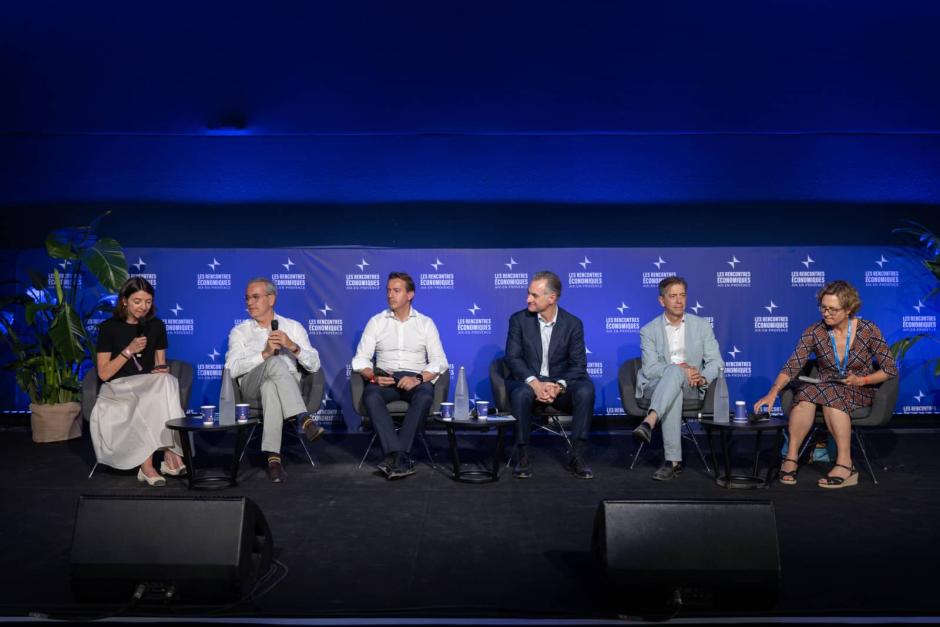
Laurence BOONE, Member of Le Cercle des économistes
Jean-Pierre CLAMADIEU, Chairman of the Board at ENGIE
Guillaume FAURY, CEO of Airbus
Nicolas NAMIAS, CEO of BPCE
Mathias BURGHARDT, Executive President of Ardian
Catherine PORTER, International Correspondent for the New York Times
Why foreign investors are choosing Europe
Why foreign investors are choosing Europe
In Ardian’s recent $20 billion infrastructure fundraise, more than 60% of the investment came from non-European investors – including those in Asia and the Gulf whose allocation to Ardian has grown fivefold since 2020. These investors were drawn to Europe precisely because of its stability, its rule of law and the diversification it offers. They were also investing in sectors identified by the Draghi report: energy transition, digital infrastructure and connectivity. “We felt a real momentum – even a renewed affection for Europe,” Mathias Burghardt said.
Ardian’s identity as a European manager has become a differentiating factor. For international investors looking to deploy capital in Europe’s critical sectors, Mathias Burghardt said, “nationality counts.”
Europe needs private capital and simpler rules to scale
Europe needs private capital and simpler rules to scale
The panel converged on a clear diagnosis: Europe must move beyond the logic of a consumer market and rebuild its own production power. For years, Europe too often relied on the assumption that open trade and low prices were enough. But geopolitical shocks of recent years – war, trade tensions with the US and China, energy vulnerability and accelerating dependence on foreign digital technology – have exposed the limits of that model. This means recovering something of Europe’s original industrial ambition to rebuild European power around strategic production and shared champions.
Europe will need an additional €750–800 billion in annual investment by 2030, according to the Draghi report. Long-term private capital is the only lever capable of operating at that scale and speed. But it comes with the condition that capital markets must deepen. European equity markets represent only 73–81% of EU GDP, compared with 270% in the US. Around €10 trillion of EU household savings, currently held in bank deposits, must be mobilized. And regulatory frameworks such as ELTIF 2.0 are needed to channel individual investors toward productive assets.
One proposal that addresses this directly is the European Commission’s “EU Inc.” initiative. This would allow the creation of a single European corporate framework for companies, enabling them to operate across the single market without establishing a separate subsidiary in each member state. Known as the 28th regime, this kind of structural reform would accelerate cross-border mergers and acquisitions within Europe and make it significantly easier to build the continental-scale champions that European sovereignty requires.
In an era of strategic competition, capital anchoring and infrastructure ownership are not neutral choices as they carry real consequences. As Ardian’s own experience shows, being European – and being perceived as European – can matter when investing in critical sectors. Building European sovereignty and attracting global capital are not competing objectives but, in fact, two sides of the same coin.
We should not fight yesterday’s battles, but tomorrow’s. We need to look at the whole value chain – not by assuming we can be competitive on every link, but by choosing the links where we can win, and which will be essential in future power relations.