Secondaries: How Ardian turns market imbalance into competitive advantage
Market watch
Secondaries: How Ardian turns market imbalance into competitive advantage
-
02 September 2026
-
Secondaries & Primaries
Reading time: 6 minutes
Selectivity in secondaries is driven by information. Ardian’s database absorbs millions of data points each quarter, enabling continuous due diligence across thousands of companies. This bottom-up approach builds strong conviction on what to buy, when and at what price – supporting disciplined selection and enabling the cherry-picking of target funds and GPs.
A $240 billion market at an inflection point
A $240 billion market at an inflection point
Secondaries have entered a new phase of faster growth and wider adoption. Private equity is leading this change, but the compelling attractions of secondary liquidity do not stop there. Infrastructure is climbing the same growth curve.
Secondary volume in private equity reached around $240 billion last year, up around a third on 2024 and double the volume in 2023. We believe the forces driving this growth are getting stronger and reinforcing each other. Many large LPs now see the secondary market as a natural way to manage their PE portfolios, and the number of new sellers is rising fast, making up almost half the market last year. But, as exits have slowed, overallocation among LPs has become a second key factor, intensifying their demand for liquidity.
From the GPs’ perspective, this shows up as a steady maturing of their portfolios. More than 80% of the unrealized value in buyout funds has now been held for at least four years, the point when a flow of exits would be expected. Instead, exits have become rarer and IRRs have fallen for recent vintages across the industry. This has driven a major evolution of the secondary market. It is no longer simply a tool for active portfolio management among LPs. It is now a key route for exits.
As a result, secondaries are now an essential tool for both LPs and GPs – a trend that explains the rapid development of the GP-led market via single- and multi-asset deals, and the wider range of GPs turning to it, including a more active midcap segment. The secondary market now delivers more than a quarter of the liquidity for buyouts. This has created a second, powerful growth engine alongside the market’s role as a portfolio management tool. The number of players for whom the secondary market can provide solutions has greatly expanded, which will continue to drive deal flow.
A structural capital shortage — and what it means for buyers
A structural capital shortage — and what it means for buyers
However, even though demand for secondary liquidity has never been stronger, the market remains structurally undercapitalized. We calculate that total dry powder is less than half the deal flow that came to market in 2025.
Demand from sellers far exceeds supply of capital among buyers and that imbalance is likely to persist, naturally favoring buyers who can bring significant liquidity to the table.
-
$18bn
Secondary deployment in 26 transactions (ASF, ASF Infra and AESF) in 2025
-
$2bn
Primary commitments in 68 funds in 2025
-
110
professionals operating in the Secondaries team across three continents
Three barriers to entry: scale, relationships and information
Three barriers to entry: scale, relationships and information
As pioneers of the secondary market and its largest player today, we are well placed to capture the opportunities this environment will deliver. Competition for the largest deals is limited: the same names that dominated secondaries ten years ago still do so today.
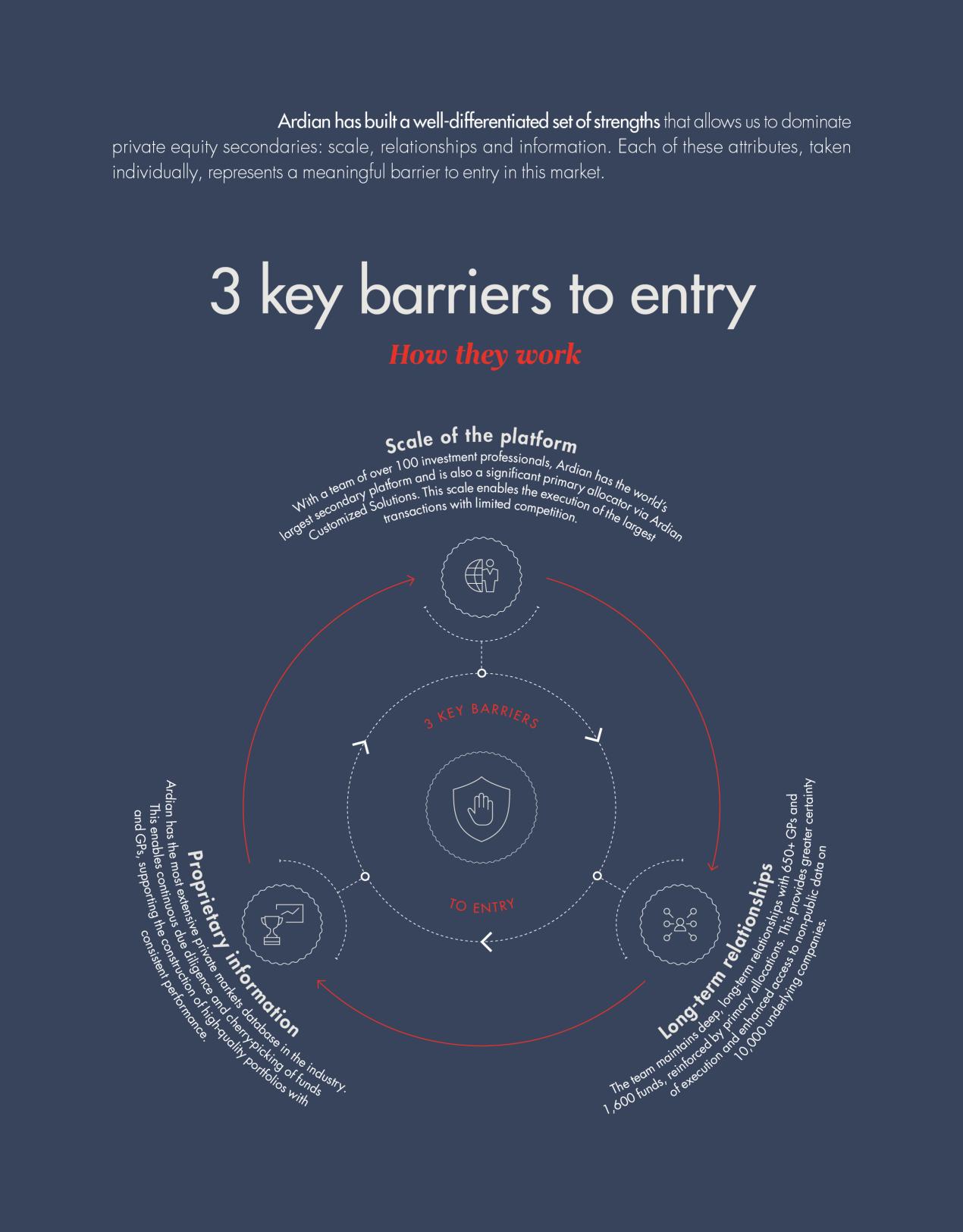
This highlights the barriers to entry that define this market in three key areas: scale, relationships and information. In each of these, Ardian has built a well-differentiated set of strengths that allows us to lead the market in private equity secondaries and will drive our growth in adjacent markets such as single- asset secondaries and infrastructure.
Scale: the biggest team in the industry
Scale: the biggest team in the industry
Scale is essential to operate as a trusted counterparty to the biggest LPs and GPs. We have built the biggest secondaries team in the industry: 110 professionals operating from 14 offices on three continents. This global strength allows us to raise and deploy record pools of capital, most recently our $30 billion ASF IX platform.
We also have unrivalled relationships with hundreds of the world’s top GPs.
Relationships: the Primary-Secondary flywheel
Relationships: the Primary-Secondary flywheel
Uniquely among the biggest secondaries players, we are also a large primary investor in buyout and infrastructure funds, deploying capital raised through Ardian Customized Solutions.
This creates deep, long-term relationships with GPs and is another vital enabler of our secondaries business. It both smooths the process of gaining their consent for asset transfers and makes them more willing to share information on their portfolio companies for our quarterly underwriting. It makes us better secondary and primary investors.
iBIP: turning 5 million data points into conviction
iBIP: turning 5 million data points into conviction
Securing privileged access to information at the individual company level is the third source of our competitive advantage. Our secondaries database, iBIP, absorbs 5 million data points each quarter, allowing us to continually underwrite thousands of companies and identify which assets we should buy, when and at what price.
This information cannot be bought. It can only be assembled, quarter by quarter over decades, by those that have the scale, the right relationships, and the team to draw on 26 years of investment judgment.
The three key differentiators in the market are scale, relationships and information.
Infrastructure Secondaries: the next growth frontier
Infrastructure Secondaries: the next growth frontier
The infrastructure secondary market today looks a lot like the buyout secondaries did a decade ago. Deal flow is growing quickly as both LPs and GPs seek to manage their portfolios dynamically and accelerate liquidity. In 2025, we saw around $28 billion of secondary infrastructure assets come to market, representing 33% annual compound growth since 2021.
As in buyouts, secondary growth tends to track the increase in primary AUM, which is up from $877 billion in 2019 to more than $1.5 trillion today. Our conviction that infrastructure, like buyouts, would develop a liquid secondary market prompted us to raise our first secondary fund more than a decade ago, which we closed in 2015 at $525 million.
That fund took two years to raise. Our current generation will take around half that time and will be 15 times larger, demonstrating that the growth we anticipated is being realized. Our leadership in this market rests on the same readily transferable advantages that we have in buyouts: scale, relationships and information. Again, our strong positioning in infrastructure primaries, through Ardian Customized Solutions, unlocks the deep, long-term relationships with infrastructure GPs that bring us access to de tailed, private information on individual assets. This enables our rolling due diligence, which helps us choose the right deals at the right time.
A privileged position in an undercapitalized market
A privileged position in an undercapitalized market
The pool of scale buyers in infrastructure secondaries is even more limited than in buyouts, which leads to a market that is significantly undercapitalized.
This puts players like us, that can buy large portfolios, in a privileged position. We differentiate ourselves from other big secondary players by offering more balanced US/European expo sure and a notably wider range of midcap funds in Europe. This is proving particularly important to LPs in today’s market.
-

Marie-Victoire Rozé Deputy Co-Head of Secondaries & Primaries and Senior Managing Director