Ardian's Infrastructure team: Europe's largest investor with an industrial edge
Market watch
Ardian's Infrastructure team: Europe's largest investor with an industrial edge
-
18 September 2026
-
Infrastructure
Reading time: 4 minutes
Last year’s landmark fundraise confirmed Ardian as the biggest infrastructure investor in Europe. The firm has built this position over 20 years, approaching essential infrastructure with deep sectorial expertise and a unique, industrial mindset.
An industrial approach to essential infrastructure
An industrial approach to essential infrastructure
More than anything else, what defines Ardian’s Infrastructure team is its industrial approach. The way it views assets is closer to that of an industrial player than to that of a pure financial investor. In practice, this means focusing on transformation: increasing capacity, improving performance and developing a vision of each asset’s potential within its value chain.
The team invests exclusively in essential infrastructure – strategic assets across transport, digital and energy that underpin the vital functioning of society. These assets are long-term by nature, with high barriers to entry and contracted revenues. More than 70% of portfolio revenues are secured over extended periods and 85% are indexed to inflation, effectively de-risking performance through predictable yield. These characteristics make this an especially attractive strategy in today’s volatile environment.
-
18TWh+
Renewable electricity generated in 2025 – equivalent to powering around 5 million homes
-
€13bn+
Cumulative capex in renewables expected by 2030
-
c.7,900km
Road networks operated
Growth is the strategy
Growth is the strategy
The Infrastructure team only invests in assets with a growth plan. That makes the approach capital-intensive by design. One sky-high example is Heathrow Airport, where Ardian has proposed a £49 billion investment over the next two decades to upgrade facilities and increase the number of passengers the hub can serve each year, while enhancing operational efficiency.
Such large-scale infrastructure projects involve significant lead times; for instance, Heathrow is working toward a possible 2035 date for a third runway. This same logic applies across energy and digital plat forms: for example, in renewables, Ardian expects to deploy over €13 billion of cumulative capex by 2030.
For us, ‘essential infrastructure’ means connectivity: transport and digital infrastructure, and the enabler of those two, which is energy.
Proprietary tools that turn data into performance
Proprietary tools that turn data into performance
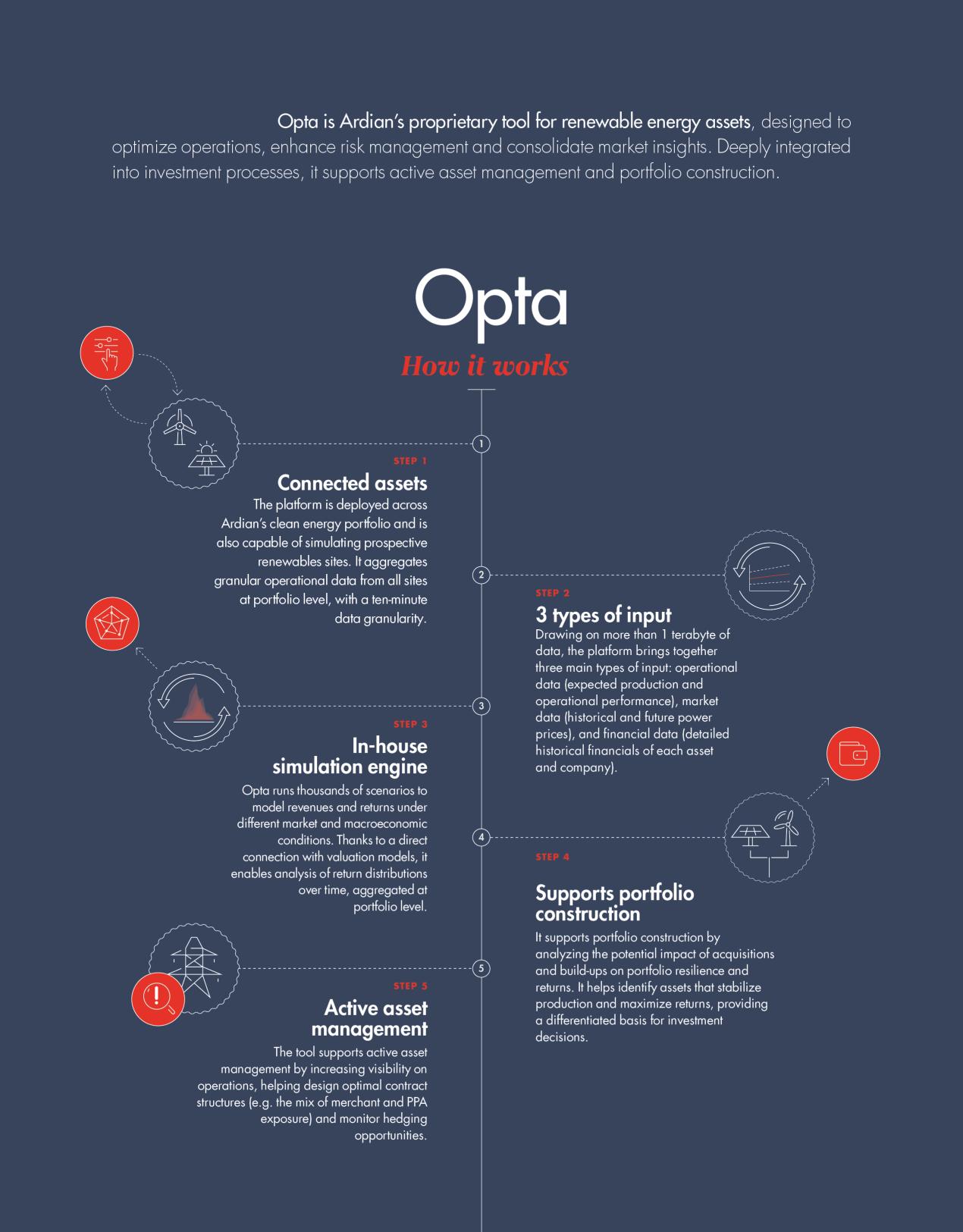
Alongside physical expansion, the firm develops proprietary tools to operate assets more precisely. Opta, its data platform for renewable energy, aggregates granular production and market data to optimize performance and contracting strategies.
Then there’s Ardian AirCarbon; developed by Ardian in 2019, the cloud-based analytics platform was designed to help airport managers measure and reduce Scope 3 emissions. The innovative tool, which generates real-time emission estimates for commercial flights and allows simulations of operational improvements, is now also used at airports not owned by Ardian.
Infrastructure that transforms communities
Infrastructure that transforms communities
Essential infrastructure is inseparable from the communities around it. Ardian actively measures its contributions to com munities and the environment and finds ways to amplify positive impact with every asset that it owns.
Take Adamo, a Spanish operator pro viding internet access to rural homes. When Ardian acquired Adamo, it served 1.8 million homes. Today, that number has grown to over 3.2 million. During Ardian’s ownership, an additional 1.5 million homes gained digital access, helping to bridge the digital gap in rural Spain and fostering local economic development – a key part of Ardian’s value-creation story.
As infrastructure needs rise with the energy transition and AI, the Infrastructure team’s approach, developed over the past 20 years, is proving well suited to the current moment.
In infrastructure, we do not look at assets through a purely financial lens. Our industrial mindset and sector expertise, combined with diligent portfolio construction, are what allow us to manage risk and create value over the long term.
-

Mathias Burghardt Chairman of the Ardian Infrastructure Management Committee
-

Juan Angoitia Member of the Executive Committee and Head of Infrastructure
-

Marion Calcine CIO of Ardian Infrastructure and Member of Ardian France Executive Board